 Chicago
 By Day
 By Deal Type
 Neighborhoods
No movie has ever loved Chicago by destroying quite this much of it. The Blues Brothers sends two guys in black suits and sunglasses across half of Cook County to pay a $5,000 tax bill, and somewhere along the way the city lets them wreck a county building, a dead mall, and — for about two years — more cars than had ever been totaled on camera before.
The 1980 movie is a John Landis-directed spinoff of a Saturday Night Live sketch, starring John Belushi and Dan Aykroyd as Jake and Elwood Blues, ex-con brothers trying to save the Catholic orphanage that raised them by putting their old band back together. It's also, almost accidentally, one of the most geographically honest movies ever made about Chicago: nearly every stop on Jake and Elwood's "mission from God" is a real address, several of them now gone, one of them now a park district wedding venue.
Here's the real map — prison to plaza, mall to market — plus the one load-bearing plot point that turns out to be entirely made up.
Joliet Correctional Center: The Only Scene Filmed Inside an Actual Former Prison
The movie opens with Elwood picking Jake up on the day of his release from the Illinois State Penitentiary at Joliet — and that's a real, working prison the crew filmed inside of, not a soundstage standing in for one. The Joliet Correctional Center had been receiving inmates since 1858 and didn't close until 2002, more than two decades after this movie used it as a backdrop.
Why it matters: The building has since become a minor tourist attraction in its own right, with public tours that lean into the Blues Brothers connection rather than away from it — a rare case of a prison's pop-culture cameo outliving the prison's actual job.
Chicago City Hall & the County Building: Two Real Scenes, One Real Building
Here's a detail most location guides skip past: Chicago's City Hall and the Cook County Building aren't two buildings. They're the same building, split down the middle — City Hall facing LaSalle Street on the west side, the County Building facing Clark Street on the east — and the movie uses both halves.
In the County Building half, Jake and Elwood pay the orphanage's back taxes at what the movie calls the Cook County Assessor's Office, in a scene where the clerk who finally accepts their payment is played by a young Steven Spielberg. (Property taxes are actually paid at the County Treasurer's office, not the Assessor's — a plot hole Cook County's own staff have joked about for years.) In the City Hall half, that same building becomes the target of the single largest police response in the movie, when hundreds of officers, state troopers, and a SWAT team converge on it mid-chase.
Fun tidbit: One building, two fictional identities, two separate action beats — the Blues Brothers version of recycling a location is just filming the other side of it.
Daley Plaza: Where 103 Cars Stopped Being a Metaphor
The movie's finale — the one where seemingly every law-enforcement vehicle in northern Illinois converges on downtown Chicago and loses — climaxes in the plaza outside the Richard J. Daley Center, right in front of the Picasso: the 50-foot untitled steel sculpture the artist donated to the city in 1967 and never gave an official name, so Chicagoans just call it "the Picasso" and move on.
By most counts, 103 vehicles were wrecked across the production — a total widely reported at the time as a record for a feature film, broken only two years later. Sources differ on the exact tally (some count 104; the stunt crew itself wasn't always sure what counted as "destroyed"), but the scale isn't in dispute: this is still one of the most expensive demolition derbies ever staged for a comedy.
A movie about a church tax bill ends with what was, briefly, the most destructive car chase ever put on film.
Dixie Square Mall: The Chase Scene Filmed Inside an Already-Dead Mall
The Bluesmobile's drive-straight-through-the-storefronts mall chase wasn't filmed in a working mall dressed up to look abandoned. Dixie Square Mall had actually closed in 1979, the year before the movie came out, and production simply brought the empty building back to life for a few weeks of filming — then left it exactly as dead as they found it.
That's the part of this story with the longest afterlife: Dixie Square sat vacant and decaying for over three more decades, becoming a genuine urban-exploration landmark specifically because of this movie, before an asbestos-removal lawsuit from the Illinois Attorney General delayed the inevitable even further. Demolition finally began in February 2012 — 33 years after the mall closed, and 32 years after Jake and Elwood drove through it.
Why it matters: Dixie Square is gone, but it's gone for reasons that have nothing to do with the movie and everything to do with how long a dead mall can sit around a Chicago suburb before anyone deals with it.
Maxwell Street: John Lee Hooker, a Deli Playing a Diner, and a Neighborhood That No Longer Exists This Way
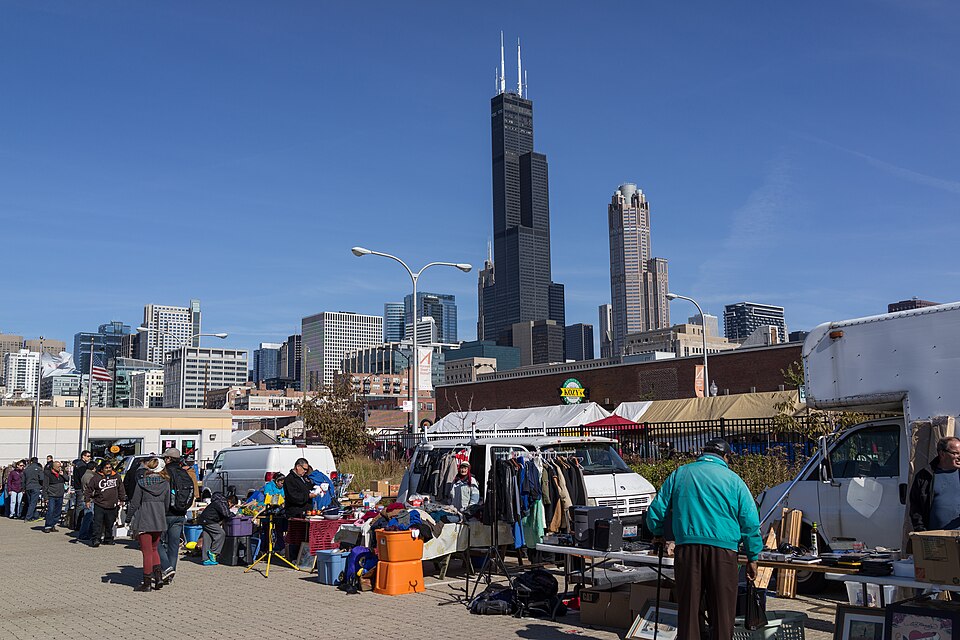
Jake and Elwood recruit two more band members outside a diner the movie calls the "Soul Food Cafe," while John Lee Hooker plays "Boom Boom" on the sidewalk with a full band behind him. The diner was a real Maxwell Street institution called Nate's Deli (originally Lyon's Deli), and the street itself was the real Maxwell Street Market — one of the city's oldest open-air markets and a genuine birthplace of Chicago electric blues, where musicians had been busking for tips since the early 1900s.
The specific block the crew filmed on was demolished around 1995 as the University of Illinois at Chicago expanded its campus. The Maxwell Street Market itself survived the move — it still runs on Sundays today, relocated a short distance east on Desplaines Street — but the exact storefronts in this scene are gone.
The Church Scene: James Brown Preaching at a Real South Side Congregation
The movie's most purely joyful musical number — James Brown as Reverend Cleophus James, tearing through "The Old Landmark" as the congregation levitates, backflips, and generally stops being a sedate church scene — was filmed at a real South Side congregation, on-screen renamed the Triple Rock Baptist Church. Most location research ties this to a Pilgrim Baptist Church on East 91st Street, though a couple of sources give conflicting street numbers for the exact address, so treat the block, not the house number, as the confirmed part. (This is a different building from the architecturally famous, Louis Sullivan-designed Pilgrim Baptist Church on South Indiana Avenue, which is a separate congregation entirely and shouldn't be confused with this one.) Some of the interior choir staging was finished on a Universal soundstage back in Los Angeles.
South Shore Cultural Center: Cab Calloway's Ballroom, Minus the Fake Name
The exterior of the fictional "Palace Hotel Ballroom" — where Cab Calloway, playing the orphanage's janitor, cuts loose on "Minnie the Moocher" — is the real South Shore Country Club building, a lakefront clubhouse built in 1906 for a membership that, notoriously, didn't admit Black or Jewish members during its country-club era. The Chicago Park District bought the property in 1974 after the club folded, and it's now the South Shore Cultural Center: a public lakefront venue that hosts weddings, concerts, and community events year-round. The ballroom interior itself was finished on a soundstage, at the Hollywood Palladium in Los Angeles.
Why it matters: A building that spent most of the 20th century restricting who could walk through its front door is now a publicly owned Chicago Park District space — which makes it a strange and pretty good landing spot for the single most purely celebratory scene in the whole movie.
Lower Wacker Drive: The City's Built-In Chase Scene
Several of the movie's car-chase sequences run through Lower Wacker Drive, the lower level of Chicago's two-tier Wacker Drive, originally engineered in the 1950s to separate through-traffic from local street traffic along the river. It's dark, it's covered, it echoes, and it has been catnip for stunt coordinators ever since — including, nearly three decades later, two separate Batman movies that used the exact same underground roadway for the exact same reason.
The One Thing in This Movie That Was Never Real
After eight real addresses, here's the part that was invented start to finish: St. Helen of the Blessed Shroud, the Catholic orphanage in fictional Calumet City whose $5,000 tax bill kicks off the entire plot, never existed. There's no real orphanage, no real Sister Mary Stigmata (Kathleen Freeman's performance is entirely the character's own invention), and no real diocesan paper trail to go looking for. The single most consequential location in the movie — the one everything else is in service of saving — is also the only one that was never on a map.
What is real, almost defiantly so: the music. Cab Calloway, Ray Charles, Aretha Franklin, James Brown, and John Lee Hooker all appear as versions of themselves, performing songs they were already associated with, in or near real Chicago locations tied to the city's actual blues and R&B history. The fictional plot is scaffolding. The musical geography underneath it is close to a documentary.
The Completionist Checklist
For anyone tracing the full, real Chicago-area footprint of this movie: Joliet Correctional Center (Joliet), the Chicago City Hall/County Building (The Loop), Daley Plaza and the Picasso (The Loop), the former Dixie Square Mall site (Harvey), Maxwell Street (Near West Side, redeveloped), the Pilgrim Baptist Church block (South Chicago), the South Shore Cultural Center (South Shore), and Lower Wacker Drive (The Loop). St. Helen of the Blessed Shroud, the orphanage the entire plot revolves around, is the one deliberate exception — because it never existed anywhere at all.
That's the real route. Eight real stops, one invented building worth $5,000 everybody was willing to wreck a city for, and a soundtrack that's more honest about Chicago than the plot is.
Get more from The Scoop
One email a week: the next field guide, Gem of the Week, and the specials worth planning around. No spam, just the good stuff. (Lower Wacker Drive gets a second life as a Batmobile chase route in the Dark Knight / Batman Begins field guide, live now.)