 Chicago
Nobody has ever called in sick with this much conviction. Ferris Bueller fakes a fever, borrows a Ferrari that isn't his, and spends a single school day touring Chicago with the confidence of a man who has never once considered consequences as a category that applies to him. Thirty-nine years later, the movie is still the single best advertisement the city never paid for.
The twist: most of it is real. Not the Ferrari. Not the house. But the city Ferris runs around in — the Board of Trade, the Art Institute, Wrigley Field, the Sears Tower (yes, we know, more on that in a minute) — that's genuinely Chicago, filmed on location in 1985 by a guy who grew up forty minutes north and never really wrote about anywhere else.
So we built the field guide. Every real stop, what's actually there now, what's quietly fictional, and the one reveal that recontextualizes the entire movie once you know it.
Shermer, Illinois Isn't on Any Map. Northbrook Is.
The exterior of "Shermer High School" is a real building: Glenbrook North High School, sitting on a real street called Shermer Road, in a real Chicago suburb called Northbrook.
That's not a coincidence. Writer-director John Hughes actually went to Glenbrook North, class of 1968. The whole fictional town of Shermer — the setting for this movie, The Breakfast Club, Sixteen Candles, and most of Hughes' other '80s work — is named after a real street he drove down as a teenager. Northbrook itself was originally platted as a town called Shermerville before it rebranded in 1923. Hughes just borrowed the old name back.
Why it matters: Every Hughes movie set in "Shermer" is secretly set in the same fictional town — which is secretly Northbrook. It's a shared universe before shared universes were a marketing strategy.
The Chicago Board of Trade: Where Ferris and Sloane Go to People-Watch
Ferris and his girlfriend Sloane spend part of the day watching traders scream and gesture on the floor of the Chicago Board of Trade, a working commodities exchange that, in 1986, was about as loud and chaotic a room as existed anywhere in the country.
The building is a genuine Chicago landmark — an Art Deco tower from 1930, topped with a faceless statue of the Roman goddess Ceres, because apparently even grain futures deserve a patron deity. The open-outcry trading floor Ferris watches has since gone almost entirely electronic, so the scene now plays as a small time capsule of a kind of financial theater that doesn't really exist in person anymore.
Fun tidbit: The building's own restaurant, Ceres Cafe, sits at street level and is named after the same statue on the roof.
The Art Institute: The Scene That Actually Explains the Movie
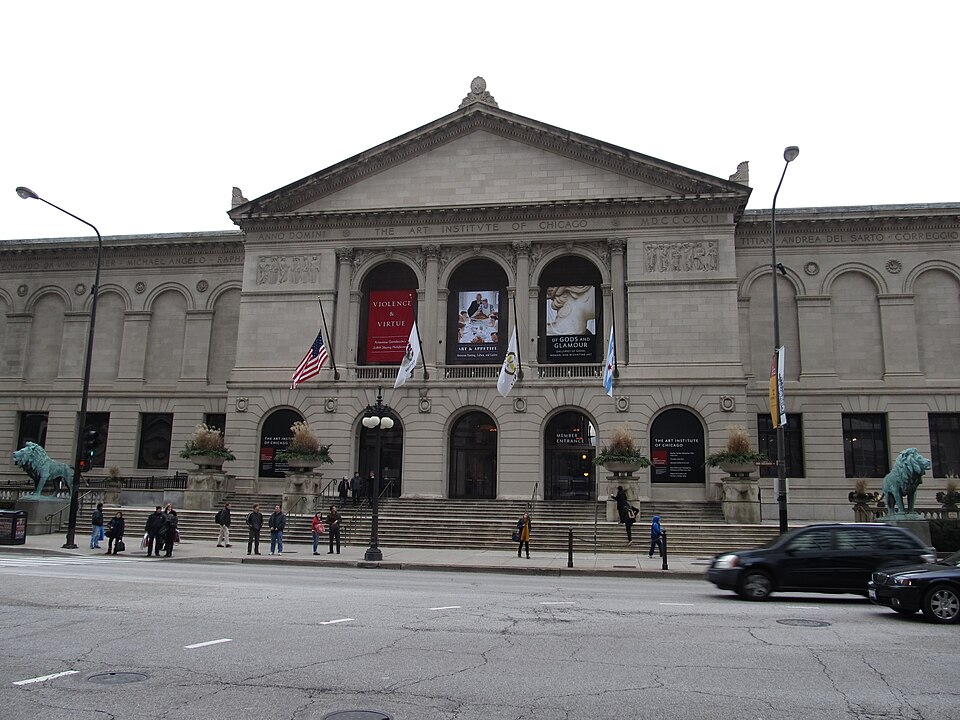
This is the one. Ferris, Sloane, and Cameron wander the real Art Institute of Chicago, and the movie slows all the way down to let Cameron stare into Georges Seurat's A Sunday on La Grande Jatte — the giant, famous, actually-hanging-in-this-museum pointillist painting of people relaxing by the river.
Hughes keeps pushing the camera closer and closer into the canvas, into the individual dots of paint, until the picture dissolves into something closer to nothing at all. It's not subtle, and it isn't supposed to be: Cameron is a kid built entirely out of other people's expectations, and the scene is asking what's actually underneath all those dots if you get close enough. The Dream Academy's cover of The Smiths' "Please, Please, Please, Let Me Get What I Want" plays underneath, and somehow that's the needle drop that makes grown adults cry during a teen comedy.
Why it matters: Of everything in this movie, this is the scene film classes actually assign. The Ferrari gets the posters. The painting gets the thesis statements.
Wrigley Field: The Game Nobody in the Movie Actually Watches
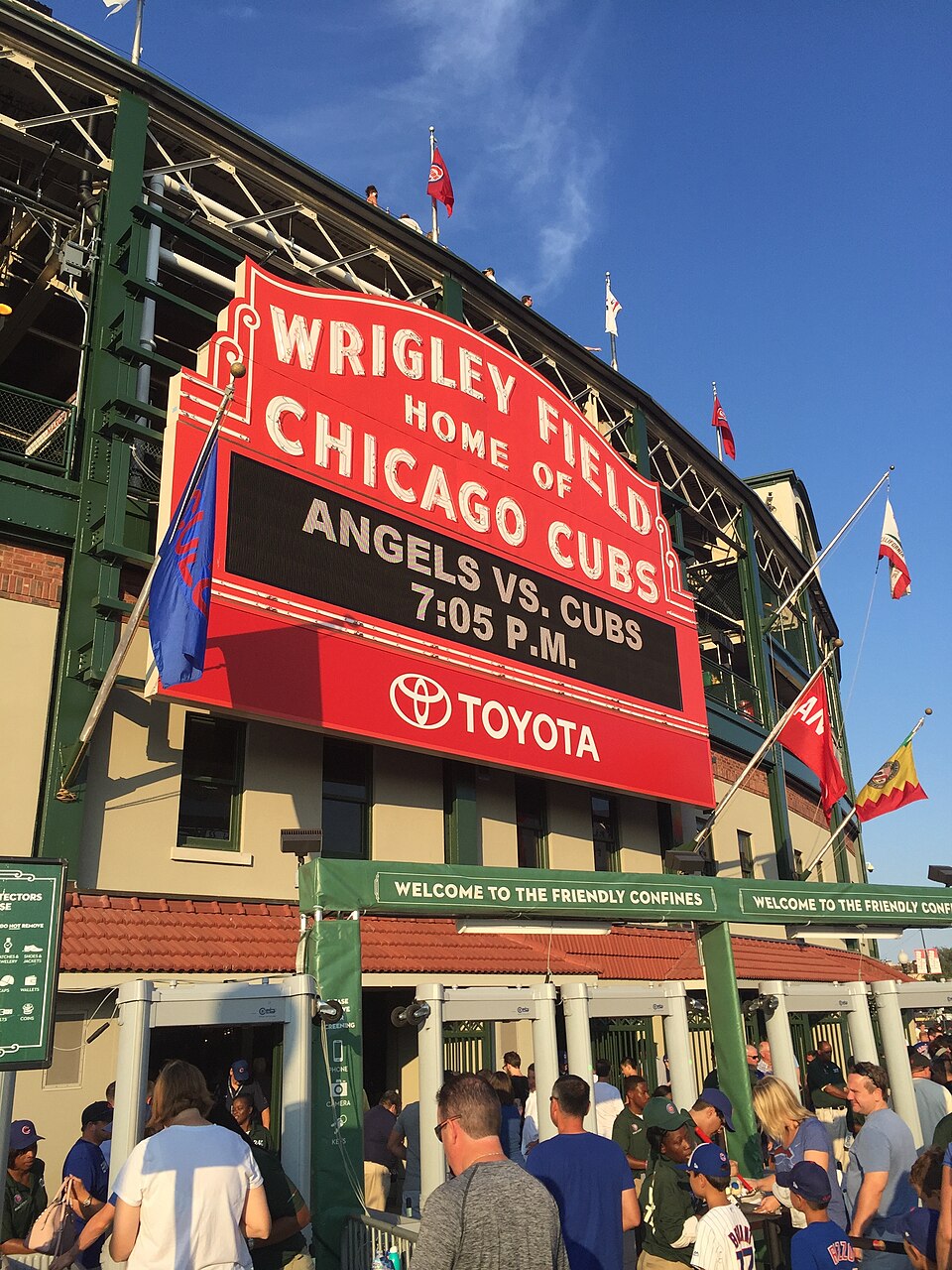
Ferris, Cameron, and Sloane catch part of a real Cubs game at Wrigley Field — still, to this day, the single most efficient way to signal "I am playing hooky and enjoying it" in American cinema.
Wrigley hasn't needed a rebrand or a renaming in the decades since. It's still Wrigley Field, still ivy on the outfield wall, still exactly the kind of place a kid skipping school would want to be seen.
The Sears Tower (We're Not Calling It Willis)
Ferris, Cameron, and Sloane take in the city from the observation deck of what was, at the time, simply the Sears Tower — and, not incidentally, the tallest building in the world.
In 2009 the building was renamed Willis Tower after its insurance-firm tenant, a change that remains, nearly two decades later, almost entirely ignored by actual Chicagoans. The movie predates the renaming by 23 years, which means this is one of the rare cases where the fictional version of a building is now more historically accurate to how people actually talk than the real sign out front.
The Scoop move: Call it Sears Tower around a local and nobody blinks. Call it Willis Tower and you will, at minimum, get a look.
Chez Quis Isn't Real (But the Building Is)
Ferris talks his way into a reservation at "Chez Quis," an exclusive French restaurant he has obviously never set foot in, by pretending to be a made-up businessman named Abe Froman, "the Sausage King of Chicago." Chez Quis does not exist. It never did. It's a fictional restaurant invented for the scene.
What's real is the exterior: a Gold Coast building on West Schiller Street stood in for the restaurant's front door. It's a private residence, not a business, so this is a look-don't-linger kind of location — the fun fact is that the fanciest restaurant in the movie is a façade in the most literal sense possible, not that it's worth a detour.
Fun tidbit: The interior dining room wasn't even filmed in Chicago — that was shot at a now-closed Los Angeles restaurant. So the whole Chez Quis sequence is, structurally, exactly as fake as Abe Froman.
The Parade: Half Real, Half a Full Production
Ferris commandeers a float during a downtown parade and performs "Twist and Shout" to a crowd that, famously, looks enormous and completely real. That's because a lot of it was.
Hughes' crew filmed partly during Chicago's actual 1985 Von Steuben Day Parade on North Dearborn Street, adding their own float into the real event. A week or so later, production staged a second, much bigger recreation with roughly 10,000 extras recruited through local radio station call-outs. A few of the people you see dancing along — a construction worker, a window washer — reportedly weren't hired performers at all. Hughes just kept the cameras rolling.
Why it matters: It's one of the most purely joyful sequences in '80s movies, and it's joyful partly because a meaningful chunk of that crowd wasn't acting.
Cameron's House Is Architecturally Famous for Reasons That Have Nothing to Do With This Movie
The glass-walled house and attached garage where Cameron's father keeps his pristine 1961 Ferrari 250GT California — the car that does not survive this movie — is a real, still-standing piece of architecture: the Ben Rose House, designed by A. James Speyer in 1953, a genuine mid-century modernist landmark in Highland Park that would be locally significant with or without a Ferrari driven through its garage door.
The famous ending, where the car goes through the glass wall and down the hillside, remains one of the most quoted stunt sequences of the decade. The exact spot used for that specific shot isn't pinned down with full confidence across sources, so we're not going to pretend otherwise — but the house itself, the one Cameron has his entire meltdown inside of, is confirmed and real.
Fun tidbit: An architecturally significant modernist house, built a decade before this movie existed, is now mostly famous for a Ferrari crashing out of it. Architecture critics have feelings about this.
Glencoe Beach: Where the Day Starts Catching Up With Cameron
A quieter beat on Lake Michigan, at a real North Shore beach in Glencoe, where the trio pauses and Cameron's anxiety starts visibly winning. It's a small, unglamorous location for a movie that spends most of its runtime inside landmarks — which is probably exactly why it works as a breather.
Here's the Twist: Ferris's House Isn't Even in Chicago
After nine real Chicago-area locations, here's the one that recontextualizes the whole movie: Ferris Bueller's own house — his bedroom, the backyard, the pool he fakes being in — was filmed in Long Beach, California. Not a Chicago suburb standing in for California. The reverse. A California house standing in for the main character's actual home.
So the kid whose entire day off is a love letter to Chicago spends his morning in a house that has never been within 2,000 miles of Illinois. We're not saying that's a metaphor for performance and authenticity. We're saying it's objectively very funny.
The kid whose entire day off is a love letter to Chicago spends his morning in a house that has never been within 2,000 miles of Illinois.
John Hughes Was a Northbrook Kid, and Chicago Never Really Let Him Forget the Favor
John Hughes wasn't born in Chicago — he was born in Lansing, Michigan, in 1950. But his family moved to Northbrook in 1963, when he was thirteen, and that's the part of his biography that actually matters to this movie. He went to Grove Middle School, then Glenbrook North, then wrote nearly his entire run of defining '80s films — this one, The Breakfast Club, Sixteen Candles, Weird Science — set in the fictional Chicago suburb named after the real street he grew up near.
Chicago, in turn, has held onto a few genuinely real tributes, none of them especially grand, all of them more charming for it:
- The real "Save Ferris" water tower. Northbrook has an actual water tower that became a minor landmark specifically because of the movie's "SAVE FERRIS" sight gag — and as of recently, the village has been weighing whether to replace the tower after nearly six decades in service, which means the most 2026-relevant John Hughes story in Chicago right now is a municipal infrastructure debate.
- A Northbrook Historical Society exhibit. In 2017, the local historical society put together a real exhibit of Hughes memorabilia — a hometown archive treating a Hollywood writer-director the way you'd treat, well, a hometown writer-director.
- Glenbrook North itself. No renaming, no official plaque out front that we could confirm — just a public high school that happens to have educated the guy who then spent a decade writing about it under a fake name.
There's no statue. No officially renamed street. We looked, and we're not going to invent one just because it would make a tidier paragraph. The actual legacy is smaller and, honestly, more fitting for Hughes' whole body of work: an unglamorous Chicago suburb that quietly kept the references around instead of turning them into a monument.
The Completionist Checklist
For anyone building an aggressively ambitious Ferris Bueller day of their own, the real, verifiable Chicago-area footprint of this movie comes down to: Glenbrook North High School (Northbrook), the Chicago Board of Trade, the Art Institute of Chicago, Wrigley Field, the Sears/Willis Tower, the Gold Coast exterior used for "Chez Quis," North Dearborn Street (the parade route), the Ben Rose House in Highland Park (Cameron's), and Glencoe Beach. Ferris's own house is the one deliberate exception — and it's in Long Beach, California, not Chicago at all.
That's the real tour. Nine real stops, one deliberate fake, and a writer who never really stopped setting his movies forty minutes from where he grew up.
Get more from The Scoop
One email a week: the next field guide, Gem of the Week, and the specials worth planning around. No spam, just the good stuff. (The Home Alone field guide is live now — same Chicago-suburbs universe, considerably more property damage.)