 Chicago
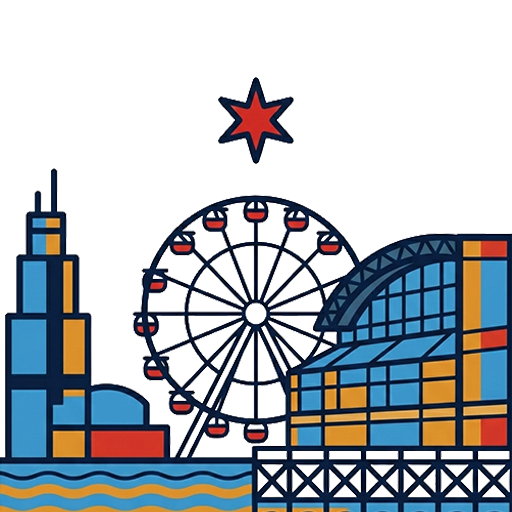
In 1893, Daniel Burnham built an entire temporary city on the lakefront, 27 million people showed up over six months, and a Pittsburgh engineer named George Ferris built something in Jackson Park nobody had ever seen before: a wheel pushing 300 feet tall, built specifically to out-do Paris.
"Make no little plans"
Daniel Burnham directed design and construction of the World's Columbian Exposition, originally alongside his partner John Root — though Root died suddenly in January 1891, well before the fair opened, and Charles B. Atwood stepped in as designer in chief. Frederick Law Olmsted, the same landscape architect behind New York's Central Park, laid out the grounds. More than 200 neoclassical buildings went up on the site, all painted a uniform, electrically-lit white — giving the whole fair its nickname, the White City. It ran May 1 through October 30, 1893, marking the 400th anniversary of Columbus's arrival in the Americas, and drew an estimated 27 million visitors to a city of just over a million residents.
Burnham didn't want the wheel
The fair needed a signature attraction big enough to answer the Eiffel Tower, which had debuted at the Paris World's Fair four years earlier. George Ferris pitched a giant rotating wheel, and Burnham's planning committee initially turned him down. Ferris reportedly spent $25,000 of his own money developing detailed plans and models to prove the idea could actually be built, and the wheel wasn't formally accepted until late in the planning process — by some accounts as late as December 1892, just months before the fair opened. What went up in Jackson Park was a wheel nearly 300 feet in diameter carrying 36 enclosed cars, each large enough to hold dozens of riders standing. It was the first Ferris wheel ever built, debuting the ride — and the name — to the entire world in one summer.
The brownie happened a few blocks away
The same fair is responsible for one of Chicago's other great food origin stories. Bertha Palmer, running the Palmer House hotel, asked her pastry chef for a dessert sturdy enough to survive a box lunch for the society women attending the fair. What he came back with still has no better name than the one it eventually got: the brownie. The full story — and exactly where to still get one, from the same hotel, off the same recipe — is its own guide.
What's actually still standing
Almost none of the White City was built to last — the buildings were made from "staff," a plaster-and-fiber material meant to look like permanent stone for one season, and most of what the fire didn't claim in 1894 was demolished or simply fell apart. Two buildings are the real exceptions. The World's Congress Auxiliary Building, where the fair hosted the World's Parliament of Religions, still stands on Michigan Avenue — it's the Art Institute of Chicago today. And the Palace of Fine Arts, designed by Atwood with a brick substructure that let it survive the 1894 fire, went on to house the Field Museum's original collection before Lorado Taft and others pushed to preserve it as a museum building in its own right. It reopened in the 1930s as the Museum of Science and Industry, still sitting in Jackson Park roughly where it was built for the fair — which means two of the city's biggest museums today are, in a very real sense, the fair's actual leftovers.
The fair gets its own six-pointed star on the city flag — here's what the other three mean.
Know another real piece of Chicago history worth telling right — a building, a block, a story behind something everyone walks past? A father and son read every nomination.
Nominate a Gem →