 Chicago
On the morning of January 2, 1900, a small crowd of engineers and two newspaper reporters watched a temporary dam get blown apart on the edge of the city. When the water settled, the Chicago River was flowing the wrong way — away from Lake Michigan instead of into it — and it's run that way, on purpose, ever since.
The problem: a city drinking its own waste
Through most of the 1800s, Chicago's sewage ran straight into the Chicago River, and the Chicago River ran straight into Lake Michigan — the same lake the entire city drew its drinking water from. That's about as bad a plumbing arrangement as a growing city can have, and it was blamed for repeat outbreaks of cholera and typhoid. Chicago had already tried raising the whole downtown out of the mud with screw jacks decades earlier; this problem needed something bigger than civil engineering inside the city limits. It needed the river itself to stop flowing toward the lake.
Isham Randolph's 28 miles
In 1889, the Illinois legislature created the Sanitary District of Chicago specifically to solve this, and the plan it landed on was almost absurd in scale: dig a new channel connecting the Chicago River to the Des Plaines River watershed, carve it deep enough and with enough of a grade that water would flow away from the lake instead of into it, and let gravity do the rest. Construction on the Chicago Sanitary and Ship Canal began September 3, 1892 — still referred to as "Shovel Day" — under chief engineer Isham Randolph, who ran the project for its full length. By some accounts the 28-mile canal cost upward of $60 million, an enormous sum for 1900. On January 2, 1900, with the canal finished, the Sanitary District's commissioners detonated the temporary dam at dawn and the river reversed, permanently, sending Chicago's wastewater toward the Mississippi and eventually the Gulf of Mexico instead of into Lake Michigan. Admiral George Dewey formally dedicated the canal that May.
Today, it just gets dyed green once a year
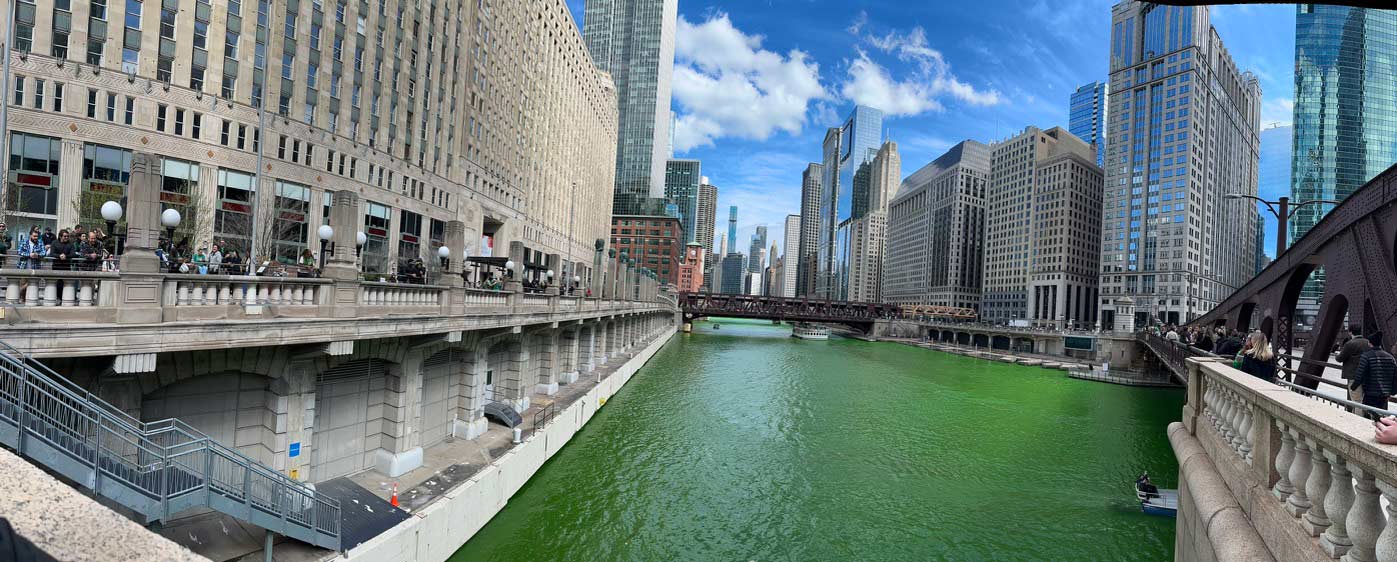
The river that was once treated as the city's literal drain is now the thing Chicago shows off on St. Patrick's Day. The dyeing tradition reportedly dates to 1962, and the most-repeated origin story credits Steve Bailey, a plumbers' union business manager and friend of Mayor Richard J. Daley, who noticed a green stain on a plumber's coveralls — dye the union used to trace wastewater leaks — and pitched dyeing the whole river for the holiday. Bailey and Daley reportedly wanted to dye all of Lake Michigan first; the river was the realistic fallback. The first year used about 100 pounds of dye and the color lingered for roughly a week. Today's version uses a smaller amount of a more environmentally friendly vegetable-based dye, and the green usually fades within a day. It's a strange, genuinely charming way for a 125-year-old engineering fix to still be part of the city's calendar.
One of the two blue bars on the Chicago flag stands for water — the lake and the river both. Here's the rest of what the flag means, star by star.
Know another real piece of Chicago history — an engineering fix, a landmark, a story behind something everyone walks past — that deserves the same treatment? A father and son read every nomination.
Nominate a Gem →